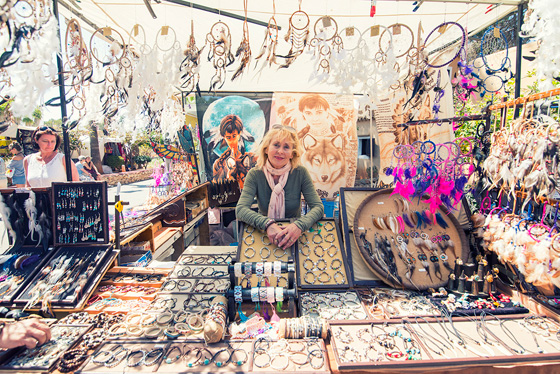
41 years being part of the Hippy Market family is a short time, but not everyone can say it. This friend arrived in Ibiza in July ’75 (two years after the little market started) and we are fortunate to still have her among us.
How did you arrive at Hippy Market?
María is from Catalonia although she lived in France for many years. During those years, she met an Australian hippie who came to Ibiza every summer and talked to her about the island. She decided to leave her comfortable life, her job as a flight attendant, and took a new course in search of a freer way to live. People around her said she was crazy, with everything she had and the education she had received.
How were those beginnings at the flea market?
She tells us that people sold what they could, as it was the livelihood of many. They made crafts, cakes… She started selling clothes and making cakes.
He has seen every stage of the Hippy Market since its beginnings and says that the change was very slow at first, that essence that existed we can feel it today on the street of craftsmen, he says it’s what reminds him the most of those years.
Starting from the 80s, the market began to grow and even today, it is the largest on the island.
What is Maria currently selling at Hippy Market?
Although she has been slowly transforming her position, now she sells Indian products, related to Indian rituals and philosophy, which have a very direct connection with Ibiza for her: freedom, respect for nature, and love.
What does the hippie soul mean to her?
Her sweet voice tells us that hippies were cultured people, against society, against the rigid and outdated social structure, they wanted freedom. She talks about the transformation that has existed and the current term “neohippie,” in which she mixes the past with the present.
For her, the hippie philosophy is respect and love for the earth, nature, the community… a connection with the earth.
What does Hippy Market mean to Maria?
It has been a way of changing life, she lived comfortably, she had everything, but she wanted to be happier and live more freely.
Everyone had the opportunity to make a living if you were creative and to live freely, without work schedules or closed social structures and that lifestyle was very comfortable for raising children, you could take good care of your children and educate them in the philosophy you liked.
She has adapted to the world and hippie lifestyle with her respect for nature, although she always nuances while maintaining her structure and following her own criteria.
An anecdote
María picked figs or carob from the island to make her cakes, there were people who didn’t have a penny and lived with what they could, they had many needs but they lived super happily without money, now you don’t see that anymore, times change she tells us. She always remembers a boy who waited until she had sold all the cake she made and who looked for her to ask her to give him the leftover dough from the cake mold to eat something.
They were not there for the money, they were there for the atmosphere, to show what they did and created, it was very beautiful, there was a lot of music, people were very calm, money was good but sometimes they went home with nothing and that was fine.